Table Of Content
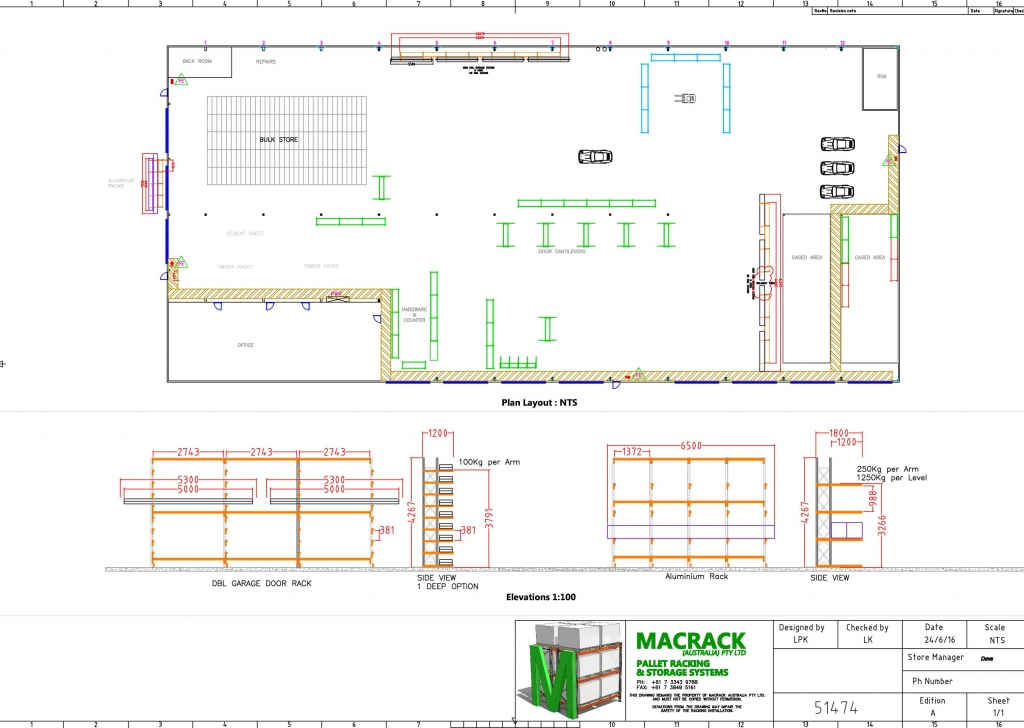
All warehouses have a different floor plan, but this one conveniently marks out the space that separates all the areas. Such layouts give a precise idea of what you can expect your warehouse to look after the plan. Warehouse layout design is crucial because it has a direct impact on business efficiency.
Utilize vertical space
The result is a reduction in lead times and improved overall operational flow. The future of workflow efficiency lies in the integration of robotics and automation. Automated guided vehicles (AGVs), robotic pickers, and smart conveyor systems are becoming integral to optimizing warehouse workflows. These technologies enhance speed, accuracy, and overall operational efficiency.
Receiving and Storing Materials In Warehouse
This includes compliance with Occupational Safety and Health Administration (OSHA) regulations and other relevant industry-specific standards. The Internet of Things (IoT) holds the promise of creating a network of interconnected devices within the warehouse. From RFID tags providing real-time location information to smart sensors monitoring environmental conditions, IoT connectivity enhances visibility, control, and responsiveness.
A Must-Have Warehouse Equipment List
The bottom of the U is where all of the inventory is stored, and either part of the extended legs is where the loading and unloading areas are located. Using a warehouse management system (WMS) can lead to lower error rates, improved overall warehouse performance, and more timely inventory replenishment. Though a WMS will not directly impact the warehouse layout design, it will impact the way you layout the equipment and work stations. Determining the space and other needs for warehouse automation systems and other equipment is one of the most crucial initial tasks in planning a warehouse layout.

Instead, rails are installed which allow goods to slide along the inside of the truck. However, if the trucks that are going to access these areas are owned by third parties and come from different sources, they will have different trailer heights. So, a system must be created that allows the difference in height to be adjusted. With so many products shuffling in and out of each warehouse, ShipBob uses a proprietary WMS to help you control inventory as we make use of unique barcodes across the warehouse.
Increased safety
Orders are assembled with meticulous accuracy, leading to a substantial reduction in returns and customer dissatisfaction. The primary objective of automation integration is to elevate efficiency and throughput to unprecedented levels. The precision, speed, and reliability of advanced technologies contribute to a seamless operational flow.
Before we continue, it’s essential to understand that the warehouse layout design should be considered at all stages of eCommerce administration, not just at the start of a company. From self-storage to manufacturing and everything in between, SmartDraw warehouse layout and design software is fast and easy. Warehouse racking is the equipment used to store and handle goods in a warehouse. The warehouse racking layout at your facility is crucial to warehouse inventory management success.
An efficient warehouse layout is essential to competitiveness in today’s market as every company seeks to streamline their eCommerce operations to satisfy client needs. Your productivity, which impacts your entire firm, will be significantly affected by your layout. It is a user-friendly tool that helps you create layouts aligned with your business needs. It also has free templates and symbols for warehouse layout makers that the designers can modify and use per their requirements.
The U shape is used to keep major warehouse traffic flow separate and streamlined. Keeping the incoming and outgoing materials on parallel sides of the operation helps to avoid bottlenecks. This flow of goods is also helpful in minimizing the available space necessary. With both the entrance and the exit sharing the same side of the building, less space is needed for packages, and employees can quickly move products between receiving and shipping.
Advancements in automation have given rise to automated vertical storage solutions, such as vertical lift modules (VLMs) and automated storage and retrieval systems (AS/RS). These systems are designed to maximize vertical space while enhancing retrieval speed and accuracy. Automated solutions are particularly relevant in high-density storage environments.
AGVs are autonomous mobile robots that navigate through the warehouse to perform various tasks. From transporting goods to specific locations to acting as robotic pickers, AGVs reduce manual labor, enhance speed, and contribute to a more agile and responsive warehouse. The application of artificial intelligence (AI) for predictive analytics is on the horizon.
Manual processes of warehouse design and layout often struggle with accurate forecasting and space optimization. Warehouse Management Systems (WMS) offer a solution by automating processes, providing real-time visibility, and enabling dynamic adjustments. The most significant objective of a warehouse layout is to optimize the way warehouse space is used. Designing an optimal warehouse layout is a meticulous process that demands careful consideration of various factors. This guide provides a roadmap to create an environment that balances efficiency, safety, and adaptability, setting the stage for a future-ready supply chain. Illuminating the path to each product, this technology leverages visual displays with lights to guide warehouse staff to the precise location of items.
Their adaptability in collaboration not only accelerates order picking but also fosters a harmonious workplace culture. Automation solutions, particularly those equipped with autonomous capabilities, unlock the potential for 24/7 operations. The warehouse transcends the constraints of traditional operating hours, operating continuously to meet the demands of a dynamic market.
This information serves as the canvas upon which the entire layout will be crafted. Identify fast-moving items that require easy accessibility and strategic placement within the layout. Simultaneously, acknowledge slower-moving items that may be stored in areas with less frequent access.
Reduce Warehouse Space with the Pareto Principle using Python - Towards Data Science
Reduce Warehouse Space with the Pareto Principle using Python.
Posted: Sun, 25 Apr 2021 18:37:54 GMT [source]
This approach has receiving docks on one side of a building, with shipping docks on the opposing side. Inventory tracking is crucial in determining how much product you have, how much storage capacity you’ll need, and which warehouse layout can accommodate those requirements. The L shape also minimizes congestions by avoiding back and forth movement and effectively separates products with inbound and outbound docks on opposite sides.
Consider the following questions to help you make better decisions as you plan your ideal warehouse layout. L-Shaped – this type of warehouse flow is commonly found in warehouses that are also shaped like an L. With this layout, there is less back and forth movement which deters bottlenecks and congestion. Receiving is at the far end of the L, with storage at the 90 degree section of the L, and shipping area at the top of the L.


No comments:
Post a Comment